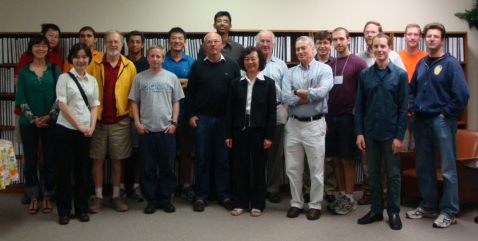
at the
American Institute of Mathematics, San Jose, California
organized by
Winnie Li, Tong Liu, Ling Long, and Ravi Ramakrishna
By a theorem of Belyi, any smooth projective curve defined over a number field is isomorphic to a modular curve for some finite index subgroup of $SL(2,\Z)$. The majority of these are noncongruence subgroups. For example, the degree 3 Fermat curve $E: x^3+y^3=1$ is the modular curve for the degree 3 Fermat group $\Phi_3$ , contained in $\Gamma(2)$. The space of weight 2 cuspforms for $\Phi_3$, denoted by $S_2(\Phi_3)$, is 1-dimensional and generated by \begin{align} f(z) =& q^{1/2}+...+70 q^{5/2}+...+23000/3^2 q^{7/2} +...+6850312202/3^3 q^{13/2} \cr =& \sum a(n) q^{n/2} . \end{align} Observe that the Fourier coefficients of $f$ are rational numbers with unbounded denominators which indicates that $\Phi_3$ is noncongruence.
On the other hand, the celebrated Taniyama-Shimura modularity theorem established by Wiles et al. says that the $\ell$-adic representation attached to $E$ comes from a weight 2 congruence normalized newform $g(z) = \sum b(n)q^n$. Atkin and Swinnerton-Dyer discovered remarkable congruence relations satisfied by the Fourier coefficients of noncongruence form $f$ and congruence form g for almost all primes $p$: $$ a(n p) - b(p)a(n) + p a(n/p) \equiv 0 \bmod p^{1+ord_p n}. $$ They further suggested that such three-term congruence relations on Fourier coefficients of noncongruence forms should hold in general for a basis depending on $p$ with suitably chosen algebraic integers replacing $b(p)$ and $p$.
Major breakthroughs in the study of noncongruence cuspforms were achieved by A. Scholl. In order to understand the Atkin and Swinnerton-Dyer congruence relations, Scholl constructed a compatible family of $2d$-dimensional $\ell$-adic Galois representations attached to each $d$-dimensional space of noncongruence cuspforms of integral weight $k \ge 2$ under general assumptions. The congruences above result from the Scholl representations attached to $S_2(\Phi_3)$ isomorphic to the $\ell$-adic Galois representations attached to $g(z)$.
Proposed below is a partial list of topics to be discussed during the workshop. The participants are welcomed to comment on it and suggest related topics of their interests.
The workshop schedule.
A report on the workshop activities.
Papers arising from the workshop: